If you’ve ever held a business card with a mirror-like shine, run your finger across a furniture panel that feels almost glass-smooth, or noticed how some product packaging looks just a little more premium than everything else on the shelf, there’s a good chance Uvlack was involved.
Uvlack is one of the most effective surface finishing technologies available today. It cures in seconds, protects against daily wear, and gives surfaces a high-end visual quality that traditional varnishes struggle to match. Yet despite its widespread use, many people in manufacturing, design, and printing have never heard the name.
This guide breaks down everything you need to know about Uvlack, from the chemistry behind it to real-world applications, finish options, and comparisons with conventional coatings.
What Is Uvlack?
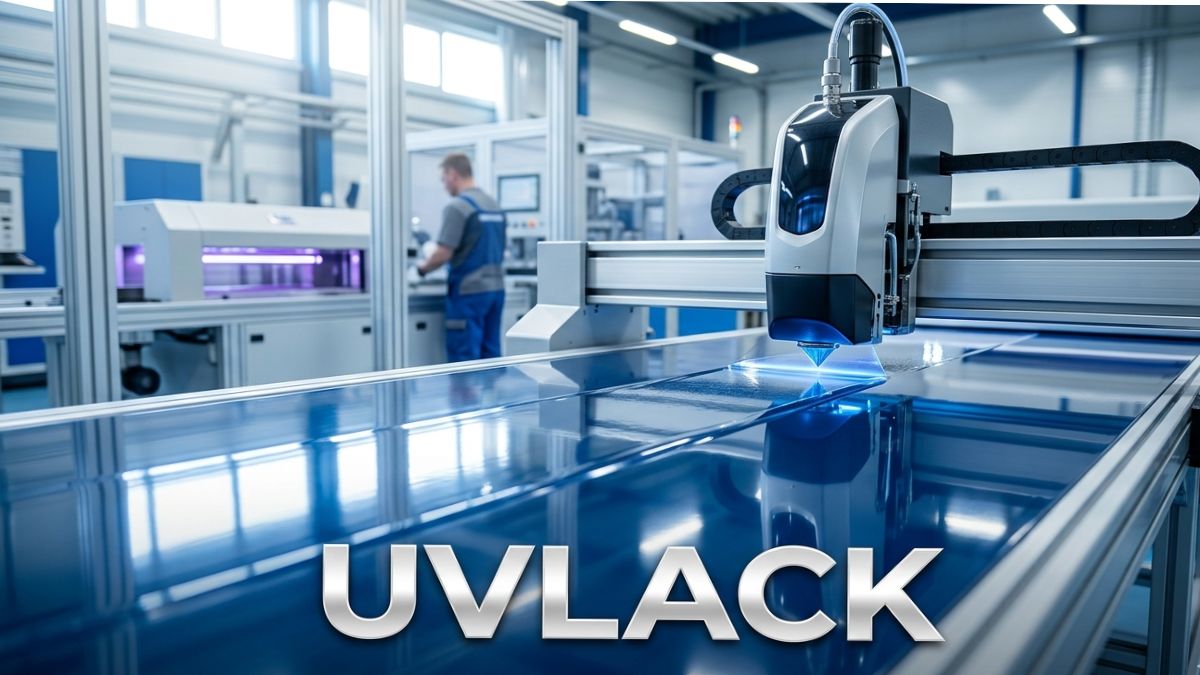
Uvlack is a high-performance coating that hardens almost instantly when exposed to ultraviolet (UV) light. Rather than relying on air-drying or heat-based evaporation, as in traditional paints and varnishes, Uvlack undergoes a controlled photochemical reaction that transforms a liquid film into a solid, durable surface layer within seconds.
The name itself is a combination of “UV” (ultraviolet) and “Lack” (the German word for lacquer or varnish), reflecting its European industrial origins. Today, it is used across manufacturing sectors worldwide, from packaging and printing to furniture, automotive interiors, and electronics.
At its most basic level, Uvlack works like this: apply the liquid coating to a surface, pass it under a UV lamp, and the coating is instantly cured, ready to handle, stack, or ship.
How Uvlack Works
Understanding UVlack means understanding what happens at the molecular level during curing. The coating contains four main components:
| Component | Role in the Coating |
|---|---|
| Oligomers | Form the structural backbone; determine hardness and flexibility |
| Monomers | Control viscosity and curing speed; influence final texture |
| Photoinitiators | Absorb UV energy and trigger the polymerization reaction |
| Additives | Enhance specific properties like gloss, scratch resistance, or anti-yellowing |
When ultraviolet light strikes the applied coating, the photoinitiators absorb that energy and instantly trigger polymerization, a chain reaction that links liquid molecules into a dense, cross-linked polymer network. This network forms the hard, protective surface film.
Because curing happens on demand rather than through slow evaporation, there is minimal shrinkage, fewer surface defects, and much greater consistency across batches. Modern systems use either traditional mercury vapor UV lamps or newer LED UV curing systems, with LED technology gaining ground due to lower energy consumption and more precise wavelength control.
Uvlack Finish Options
One of the most underappreciated features of Uvlack is just how flexible it is in terms of appearance. Depending on the formulation, Uvlack can produce several distinct finish types:
- High-Gloss Finish: A mirror-like, reflective surface that deepens color saturation and gives printed materials and product packaging a premium look. Common on business cards, cosmetic boxes, and retail displays.
- Matte UV Finish: A low-sheen, soft-touch appearance popular in modern minimalist design. Frequently used on book covers, luxury packaging, and interior panels.
- Satin Finish: A middle ground between gloss and matte; subtle sheen with good depth.
- Soft-Touch / Velvet Finish: A tactile, velvety texture that enhances perceived product quality. Often used in high-end cosmetics and electronics packaging.
- Textured / Raised Finish: Spot applications that add dimension and pattern, creating visual and tactile contrast.
This versatility is a major reason Uvlack has replaced older finishing methods in so many industries. One coating system can serve both a high-gloss brochure and a sophisticated matte furniture panel.
Where Uvlack Is Used
Printing and Packaging
This is where Uvlack is perhaps most visible to everyday consumers. Labels, brochures, folding cartons, business cards, and magazine covers all benefit from UV coating.
A particularly popular technique is Spot UV, where high-gloss UVlack is applied only to selected areas, a logo, an image, or a headline, while the rest of the surface stays matte. The contrast creates a striking visual effect that draws the eye without a word being printed.
Furniture and Wood Finishing
Cabinet makers, flooring manufacturers, and decorative panel producers rely on Uvlack for its protective durability. A UV-cured finish on a kitchen cabinet resists moisture, cleaning agents, and the repeated scratching of daily use far better than a standard varnish. It also maintains color clarity over time without the yellowing that affects some older coating systems.
Automotive Interiors
Interior trim pieces, dashboards, door panels, and decorative surfaces in modern vehicles are frequently finished with UV-cured coatings. These components need to look good while surviving years of UV exposure, temperature changes, and physical contact. Uvlack handles all of these demands reliably.
Electronics and Consumer Devices
Smartphones, tablets, and laptop casings are finished with Uvlack to deliver a premium tactile feel, fingerprint resistance, and protection against everyday wear. For products where appearance and longevity both matter, it is an ideal solution.
Industrial and Specialty Applications
Beyond these core sectors, Uvlack is expanding into aerospace components, architectural glass panels, and even 3D-printed part finishing anywhere that demands a fast, durable, high-quality surface treatment.
Uvlack vs. Traditional Coatings: A Direct Comparison
| Feature | Uvlack (UV Coating) | Traditional Solvent Varnish | Lamination Film |
|---|---|---|---|
| Curing Speed | Seconds | Hours to days | Minutes (heat press) |
| Scratch Resistance | Excellent | Moderate | Good |
| VOC Emissions | Very low | High | Low to moderate |
| Finish Variety | Gloss, matte, satin, soft-touch | Limited | Gloss or matte only |
| Production Efficiency | Very high | Low | Moderate |
| Equipment Cost | Higher initial investment | Low | Moderate |
| Repair / Recoating | Possible with surface prep | Easy | Difficult |
The table makes the trade-offs clear. Traditional varnish is cheaper to set up but slower and less durable. Lamination is easy, but it limits finish options and complicates repairs. Uvlack costs more up front but delivers superior performance, versatility, and production speed over time.
Key Benefits of Uvlack
- Instant Curing: Products can be handled, packed, and shipped almost immediately after finishing, dramatically reducing production cycle time.
- Superior Durability: The cross-linked polymer network is highly resistant to scratches, abrasion, moisture, and most common chemicals.
- Consistent Quality: Because curing is light-triggered rather than temperature or humidity-dependent, finish consistency is easier to maintain across large production runs.
- Low VOC Emissions: Many Uvlack formulations produce significantly fewer volatile organic compounds than solvent-based alternatives, improving workplace air quality and meeting environmental compliance standards.
- Visual Enhancement: Deepens color contrast, increases perceived product value, and supports a wide range of aesthetic effects.
- Space Efficiency: No large drying ovens or long drying tunnels needed, freeing up valuable floor space in production facilities.
Challenges and Limitations to Know
No technology is without its trade-offs. Before adopting Uvlack, it’s worth understanding where challenges can arise:
- Equipment Investment: UV curing lamps and associated systems represent a high initial cost, particularly for smaller operations.
- Surface Preparation: Dust, oils, or moisture on the substrate can interfere with adhesion and finish quality. Porous materials may require sealing before application.
- UV Shadowing: On complex or irregular shapes, areas that receive insufficient UV light exposure may cure incompletely. Process design must account for this.
- Formulation Sensitivity: Applying too thick a layer can prevent full curing through the depth of the coating. Precision in application is essential.
- Operator Training: Getting consistent results requires properly trained staff who understand both application technique and curing equipment.
How Uvlack Is Applied
The method used to apply Uvlack depends on the surface type, production volume, and desired finish quality:
- Spray Application: Best for large or irregularly shaped surfaces; delivers thin, uniform layers across complex geometries.
- Roller Coating: Efficient for flat panels and high-volume flat-surface production lines.
- Screen Printing (Spot UV): Allows precise placement of coating on selected areas of a printed surface for contrast effects.
- Flood Coating: Covers the entire surface evenly; used when full-surface protection is the goal.
The Future of UVlack Technology
The Uvlack market is not standing still. Several developments are actively reshaping the technology:
LED UV Curing is displacing traditional mercury vapor lamps. LED systems are more energy-efficient, have longer service lifetimes, and can be tuned to specific wavelengths for different formulations. Some advanced systems now integrate AI-based exposure control, adjusting UV intensity in real time based on surface reflectance.
Nano-additive formulations are creating multifunctional UVlack variants with anti-fingerprint, antimicrobial, and self-cleaning properties, opening new applications in medical devices, smart packaging, and renewable energy panel coatings.
Market analysts place the global UV coatings sector at several billion USD in 2025, with consistent growth projected through the decade, driven by sustainability regulations and industrial demand for faster, cleaner production systems.
Conclusion
Uvlack is not a trend. It is a mature, proven finishing technology that has fundamentally changed how surfaces are protected and finished across dozens of industries. Its combination of instant curing, genuine durability, low environmental impact, and exceptional visual versatility makes it hard to beat for any application where surface quality matters.
Whether you are a manufacturer evaluating coating systems, a designer specifying finishes, or simply curious about what makes modern products look and feel the way they do, understanding Uvlack means understanding one of the most effective tools in contemporary surface engineering.
As LED UV technology matures and nano-additive formulations expand what is possible, Uvlack will only become more capable and more widely used. The surfaces around you, from the packaging on your desk to the dashboard in your car, are already proof of that.
FAQs About Uvlack
What does Uvlack mean?
Uvlack combines “UV” (ultraviolet) and “Lack” (German for lacquer), referring to a UV-curable surface coating that hardens under ultraviolet light.
Is Uvlack safe to use?
When applied and cured correctly with appropriate safety equipment, Uvlack is safe. Low-VOC formulations also make it safer than many solvent-based alternatives in workplace environments.
Can Uvlack be applied to any surface?
It bonds well to wood, metal, plastic, paper, and composites, though porous substrates may require a primer or sealer coat first for optimal adhesion.
How long does a Uvlack finish last?
With proper surface preparation and application, Uvlack finishes are highly durable and can last for years, even on high-traffic surfaces like kitchen cabinetry and flooring.
What is Spot UV in printing?
Spot UV is a technique where Uvlack is applied selectively to specific areas, such as a logo or image, on a printed surface, creating a high-gloss accent against a matte background.
Is Uvlack environmentally friendly?
Most modern UVlack formulations produce very low VOC emissions compared to solvent-based coatings, making them a more sustainable choice for environmentally conscious manufacturers.
Can Uvlack coatings be repaired?
Yes. Light surface abrasion followed by recoating can restore a Uvlack finish without needing to replace the entire component, which reduces material waste and operational costs.