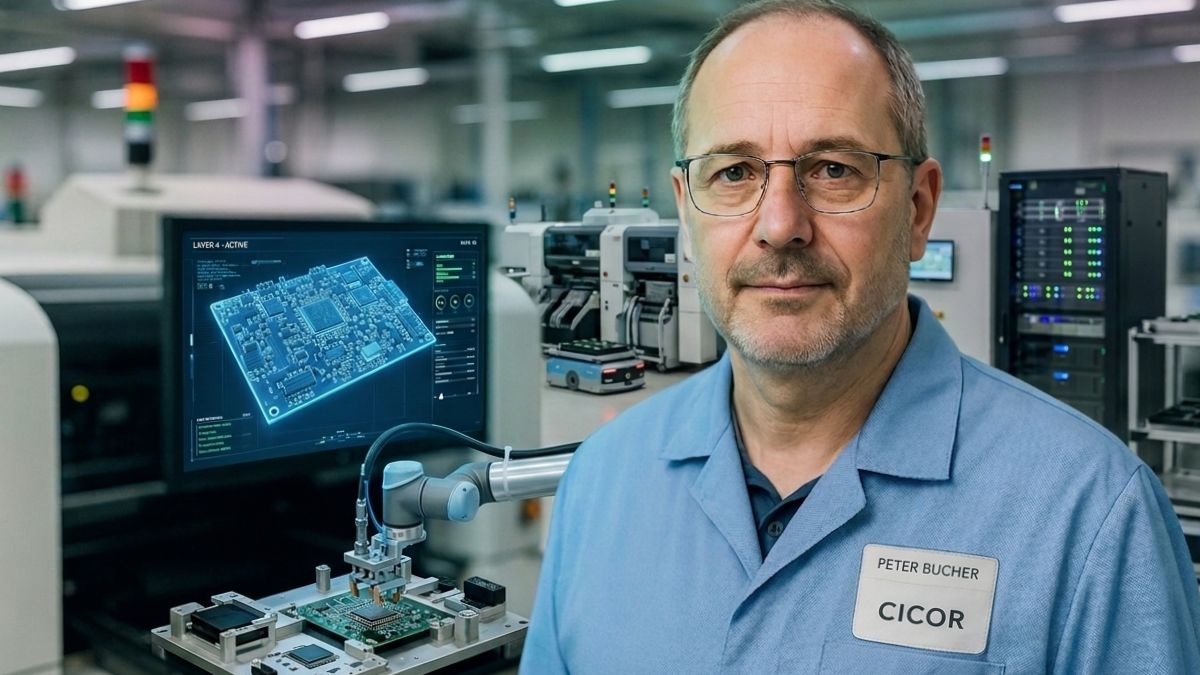
Not every influential figure in manufacturing gets the spotlight they deserve. Some of the most impactful professionals in industrial history have spent their careers quietly solving the kinds of problems that, left unattended, would grind entire production floors to a halt. Peter Bucher at Cicor is exactly that kind of person.
He is the Head of Operations at Cicor’s Bronschhofen site in Switzerland, a facility that produces precision electronic assemblies for some of the most demanding industries on the planet, including medical technology, defense, and industrial systems. But Peter’s story doesn’t start at Cicor. It starts in 1985, in the gritty, technical world of vacuum engineering, where a young process engineer learned that getting details wrong isn’t an option.
Over the following four decades, Peter moved through roles that most engineers never get to touch from compressor projects in the oil and gas sector, to leading logistics automation at a globally respected EMS provider. He isn’t a headline-chaser. He’s the type of leader who fixes the thing before anyone else notices it was broken, and then quietly builds a system to make sure it never breaks the same way again. That’s what makes him worth knowing about.
Who Is Peter Bucher? A Quick Overview
Peter Bucher is one of the most recognized operational leaders in the electronics manufacturing services (EMS) industry. As the Head of Operations at Cicor’s Bronschhofen facility in Switzerland, he has built a reputation for turning complex supply chain challenges into streamlined, technology-driven systems. His career spans decades and multiple engineering disciplines, from vacuum and compressor technology to precision electronics manufacturing. Whether you’re an industry professional, investor, or someone simply curious about the minds shaping modern manufacturing, Peter Bucher’s story offers real, practical insight.
| Detail | Information |
|---|---|
| Full Name | Peter Bucher |
| Current Position | Head of Operations, Cicor Bronschhofen |
| Industry | Electronics Manufacturing Services (EMS) |
| Based In | Bronschhofen, St. Gallen, Switzerland |
| Career Began | 1985 |
| Employer | Cicor Group / Swisstronics Contract Manufacturing |
How It All Started: The Vacuum Technology Years (1985)
Peter Bucher walked into the engineering world through one of its more unforgiving doors. In 1985, he took a position as a process engineer in vacuum technology at Sulzer Burckhardt, a Swiss industrial engineering firm with a long track record in compressor and turbomachinery systems.
Vacuum technology sounds abstract until you realize how many critical industries depend on it — pharmaceutical production, chemical processing, semiconductor fabrication. In these settings, even a minor engineering error doesn’t just cost money. It can compromise product integrity, contaminate entire batches, or create conditions that endanger workers. Peter learned early that the margin for error in precision engineering is essentially zero.
Working at Sulzer Burckhardt gave him more than just technical know-how. It built a professional mindset that he has carried through every role since, one rooted in thoroughness, anticipation of failure, and the understanding that a well-designed process is one that holds up under pressure, not just in ideal conditions.
Competencies He Built in Those Early Years
- Hands-on design and maintenance of vacuum and compressor systems
- Project delivery in pharmaceutical, chemical, and industrial environments
- Working under strict quality and safety constraints from day one
- Managing deliverables that required coordination across multiple engineering disciplines
Building on the Foundation: NSB Gas Processing and Busch
After establishing himself at Sulzer Burckhardt, Peter took on leadership responsibilities that pushed him further up the operational chain. At NSB Gas Processing, he managed projects tied to compressor systems in the oil and gas sector, an environment where scale, timeline pressure, and financial stakes are all considerably higher than in most industrial settings.
These weren’t projects you could course-correct on the fly. They involved international stakeholders, long procurement lead times, and equipment that had to perform correctly from the moment it was commissioned. Peter’s ability to manage that complexity without losing sight of the technical details set him apart from peers who could do one or the other, but rarely both.
His time at Busch, one of the world’s leading vacuum technology manufacturers, added another dimension to his profile. Busch operates across dozens of countries, and working within that structure meant navigating different markets, different regulatory landscapes, and different client expectations simultaneously. By the time Peter eventually moved toward Cicor, he had a professional foundation that very few operations leaders in electronics manufacturing could claim.
Peter Bucher and Cicor: Where His Career Found Its Fullest Expression
What Cicor Actually Does
Before understanding Peter’s role, it helps to understand the company he works for. Cicor Group is a Switzerland-headquartered provider of electronics manufacturing services, operating under the Swisstronics Contract Manufacturing brand at its Bronschhofen location. The company isn’t making consumer gadgets. It’s producing the kinds of electronic assemblies that go inside medical diagnostic equipment, industrial control systems, defense hardware, and transport infrastructure — products where failure isn’t a support ticket, it’s a crisis.
The clients that Cicor serves come from sectors that demand the following:
- Medical Technology — zero tolerance for traceability gaps; every component must be traceable to its original batch
- Industrial Systems — electronics that must perform in harsh, often remote environments for years without failure
- Defense & Transport — precision-built assemblies that meet strict security and resilience standards
- Consumer Goods — competitive pricing and rapid production cycles without sacrificing quality
What Peter Bucher’s Role Actually Involves
As Head of Operations, Peter manages the flow of materials through Cicor’s Bronschhofen site — from the moment a delivery truck pulls up to the loading dock to the point where components reach the production floor. That might sound straightforward. It is anything but.
The Bronschhofen site handles over 16,000 distinct material numbers. Each of those needs to be received, verified, catalogued, and stored in a way that allows the facility to pull any individual component and trace it back to its manufacturer’s batch number — sometimes years after it was first received. For a site producing medical electronics, that level of documentation isn’t optional. It’s a regulatory requirement.
Peter Bucher Signature Achievement
The Supply Chain Flood Nobody Saw Coming
The global component shortage that hit the electronics industry in the early 2020s created a problem at Bronschhofen that was simultaneously logistical, operational, and almost physical. To protect production continuity, Cicor, like most manufacturers, placed orders with multiple suppliers and built up safety stocks wherever possible. The result? Parcel deliveries to the Bronschhofen site temporarily increased by up to five times the normal volume.
Before automation, every one of those packages had to be opened by hand, its contents checked against purchase orders, and the components manually logged into the system. With five times the parcels coming through the door, the team was processing mountains of packages while simultaneously trying to identify which ones contained urgent materials that production lines were waiting for. It was, as Peter later described it, a situation that forced them to set priorities fast.
The iWE Solution: Peter’s Answer to the Problem
Peter Bucher didn’t respond to the crisis with a temporary workaround. He responded with a structural solution. Working alongside CompControl, the team implemented the iWE (intelligent Warehouse Entry) system — an automated goods receipt platform that fundamentally changed how incoming materials were processed at Bronschhofen.
Here’s what that system actually delivered:
- Automated parcel processing that eliminated the bottleneck of manual inspection for routine deliveries
- Direct ERP integration, meaning data captured at the warehouse door flowed straight into production planning systems without re-entry
- Real-time component tracking across all 16,000+ material numbers on-site
- Batch-level traceability, ensuring every component could be linked back to the manufacturer’s original production batch essential for medical device compliance
- Priority flagging, so that components blocking production lines could be identified and pulled from incoming shipments before the rest of the backlog was processed
The difference between before and after wasn’t marginal. It was categorical. What had been a bottleneck that threatened production schedules became a managed, data-driven workflow that actually got stronger as volume increased.
A Model the Rest of Cicor Wants to Copy
When something works this well in one location, the rest of the organization takes notice. Other Cicor production sites across the group have expressed strong interest in adopting the iWE framework, and plans are actively in development to roll it out at a group level — creating a standardized but adaptable approach to goods receipt and logistics that carries Bronschhofen’s lessons into other markets and facilities.
The Way Peter Leads: No Pretense, Just Results
There’s a particular kind of intellectual honesty that distinguishes genuinely good operational leaders from those who simply manage upward well. Peter Bucher has it. When discussing the iWE implementation publicly, he didn’t oversell it. He acknowledged plainly that the system only works if employees keep the data accurate and that keeping 16,000+ material numbers updated is, in his own words, “not really fun for every employee.” He said the effort is significant. And then he explained exactly why it matters and why the team does it anyway.
That kind of transparency isn’t common. Most leaders either gloss over the friction that comes with transformation or delegate the difficult conversation entirely. Peter does neither. His view, shaped by decades of working in industries where the gap between a good system and a poor one is measured in real consequences, is that honesty about difficulty is part of respecting the people who do the work.
His operational philosophy, distilled from four decades of experience, comes down to a few consistent principles:
- Get ahead of complexity: waiting for a problem to force your hand means you’ve already lost ground
- Data is only as good as the people maintaining it: automation amplifies accuracy, but it also amplifies neglect
- Clients feel every operational decision you make: what happens in the warehouse shows up in delivery windows and compliance records
- Trust is earned through consistency, not promises: in EMS, relationships last because reliability does
- Improvement is a permanent project, not a milestone: no version of operations is “done.”
What Peter Bucher Has Given the EMS Industry
Stepping back from Cicor specifically, Peter’s contributions have value beyond a single facility or company. He has demonstrated with documented, real-world results that:
- Automation in goods receipt is not just for large-scale logistics companies. A mid-sized EMS site can implement intelligent warehouse systems that rival the traceability and throughput of operations five times its size.
- Supply chain disruptions, while damaging, can be the pressure that forces better permanent systems. The pandemic-era component shortage created a crisis at Bronschhofen. Peter turned it into a structural upgrade.
- An engineering background matters in operations leadership. The reason Peter thinks about traceability the way he does isn’t because he read about it in a management textbook. It’s because he spent years in industries where the cost of untraceable failure is catastrophic.
Peter Bucher’s Personal Life
Peter Bucher lives and works in Switzerland, a country whose professional culture is unusually well-aligned with the way he operates. Swiss manufacturing has a global reputation for precision, long-term thinking, and a deep aversion to cutting corners, values that are visible in every decision Peter has made at Cicor.
He keeps his personal life private, which is fairly standard for senior professionals in Swiss industrial circles. What emerges from those who know him professionally, however, is a picture of someone whose character is entirely consistent whether he’s in front of a client, walking the warehouse floor, or talking to a trade publication. There’s no performance, no carefully managed persona. He speaks directly, acknowledges what’s hard, and stays focused on what the work actually requires.
That consistency between who he appears to be publicly and how he actually leads day to day is perhaps the most telling thing about Peter Bucher as a person. In an industry where the pressure to project confidence can sometimes outpace the commitment to get things right, he seems to have little interest in the performance and a lot of interest in the outcome.
Career Timeline
| Period | Role | Organization |
|---|---|---|
| 1985 | Process Engineer — Vacuum Technology | Sulzer Burckhardt |
| Late 1980s–1990s | Engineering & Project Leadership | NSB Gas Processing |
| 1990s–2000s | Senior Operations Leadership | Busch |
| Present | Head of Operations | Cicor Group / Swisstronics, Bronschhofen |
Why Peter Bucher’s Story Is Worth Paying Attention To
There are plenty of people in industrial leadership who reached their positions through the right schools, the right networks, or the right moment of luck. Peter Bucher is not that story. He is someone who started doing difficult technical work in 1985, stayed curious, moved through industries that punished carelessness, and gradually became the kind of leader that organizations rely on when things get genuinely complicated.
His work at Cicor, especially the iWE implementation and the traceability systems that now support medical-grade production, is the kind of contribution that doesn’t generate press releases but does generate results. Other Cicor sites want to replicate it. That’s the real measure.
For anyone working in operations, manufacturing leadership, or supply chain management, Peter’s career offers something more valuable than inspiration. It offers a practical model: build your expertise where the stakes are real, stay honest about what works and what doesn’t, and solve problems in ways that don’t have to be solved again.
Conclusion
Peter Bucher has spent four decades doing what most leaders talk about: building systems that actually hold, making decisions that prioritize long-term resilience over short-term convenience, and leading people without pretending that transformation is easy. His career at Cicor represents the culmination of everything he built before it: the engineering discipline from Sulzer Burckhardt, the scale awareness from NSB Gas Processing and Busch, and the understanding that in precision manufacturing, the details aren’t details — they’re the whole point. He is, without much noise or fanfare, exactly the kind of person the industry needs more of.
Frequently Asked Questions
Who exactly is Peter Bucher at Cicor?
Peter Bucher is the Head of Operations at Cicor’s Bronschhofen site in Switzerland, responsible for warehouse management, incoming goods processing, and supply chain operations for a precision electronics manufacturer.
What is Cicor Group, and what does it manufacture?
Cicor Group is a Swiss electronics manufacturing services company that produces electronic assemblies and complete systems for medical technology, defense, industrial, and consumer goods sectors.
What was Peter Bucher’s biggest professional achievement?
Implementing the iWE automated warehouse system at Cicor Bronschhofen — a project that solved a critical supply chain bottleneck and is now being adopted across other Cicor sites globally.
Where did Peter Bucher’s engineering career begin?
He started in 1985 at Sulzer Burckhardt in Switzerland, working as a process engineer in vacuum technology for pharmaceutical, chemical, and industrial clients.
Why does Cicor place such emphasis on component traceability?
Because the company manufactures electronics for medical devices, every component must be traceable to its original manufacturer’s production batch to satisfy strict safety and regulatory requirements.
What industries has Peter Bucher worked across during his career?
Vacuum technology, pharmaceutical and chemical processing, oil and gas compressor systems, and electronics manufacturing services — an unusually broad technical base for a single career.
Is the iWE system Peter helped implement being used elsewhere in Cicor?
Yes, the results at Bronschhofen have prompted active plans to expand the iWE framework to other Cicor production sites across the group.