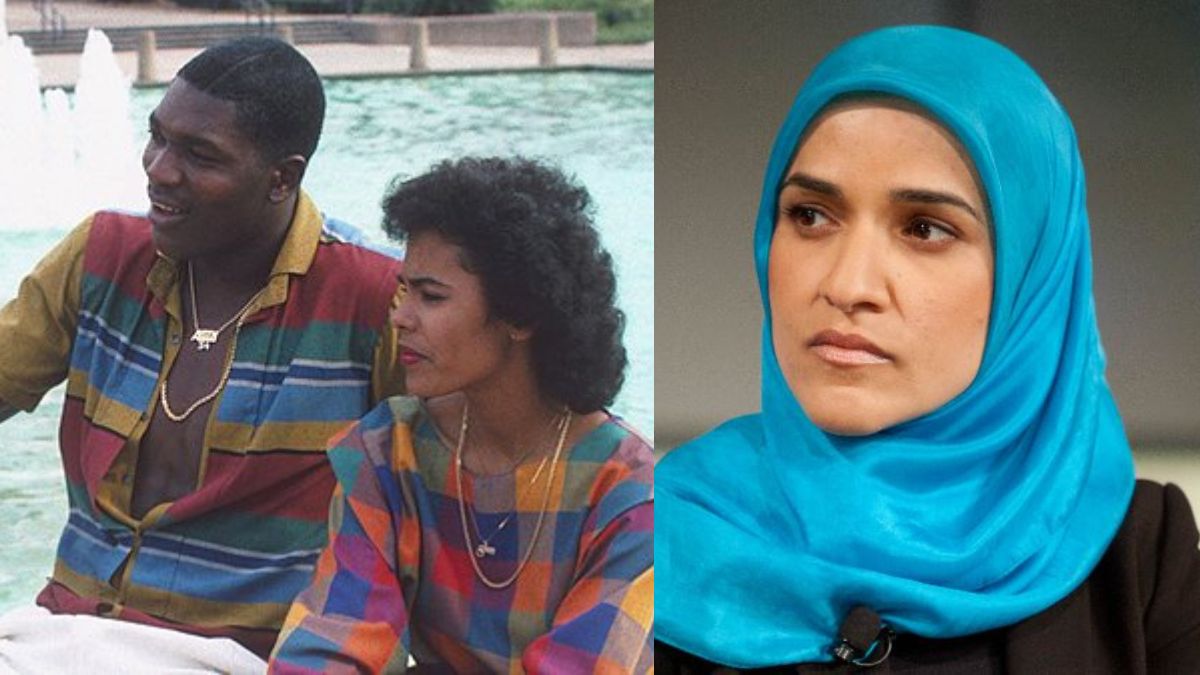
Some people live their entire lives in the background and still manage to leave a lasting impression on everyone around them. Dalia Asafi is one of those people. She is the wife of NBA legend Hakeem Olajuwon — a man the basketball world calls “The Dream,” yet Dalia herself has never tried to share in that spotlight or borrow from his fame. She has quietly built a life centred around faith, family, and purpose, staying largely invisible to the outside world for nearly three decades.
It is precisely this mystery that makes people so curious about her. Fans of Hakeem Olajuwon frequently search for details about the woman he chose to build his life with, because she is never seen at courtside events, never posts on social media, and is rarely mentioned in interviews. This article pulls together everything that is known about Dalia Asafi — her early years in Nigeria, how she met one of the greatest basketball players in history, the story behind their unique marriage, her children, and what her life looks like today.
Who Is Dalia Asafi?
Dalia Asafi is a Nigerian-born woman who became known worldwide through her marriage to Hakeem Olajuwon on August 8, 1996. Before that, she had no public profile and no connection to the sports world. After the marriage, she continued to live in much the same way quietly, modestly, and entirely on her own terms.
While Hakeem was collecting NBA championships, MVP awards, and Hall of Fame honours, Dalia was at home raising their children, maintaining their household, and keeping the family rooted in their shared faith and cultural values. She never gave interviews, never sought celebrity status, and by all accounts never wanted any of it.
That choice — to live privately despite being married to a global icon is what makes her story so compelling and so different from what people tend to expect from an NBA wife.
Dalia Asafi: Bio / Wiki Quick Reference
| Detail | Information |
|---|---|
| Full Name | Dalia Asafi Olajuwon |
| Date of Birth | Approximately 1978 (exact date unconfirmed) |
| Age in 2026 | Around 48 years old |
| Birthplace | Nigeria, West Africa |
| Nationality | Nigerian |
| Ethnicity | Nigerian-African (possibly Hausa-Fulani heritage) |
| Religion | Islam |
| Marital Status | Married |
| Husband | Hakeem Olajuwon (married August 8, 1996) |
| Children | 4 biological + 1 stepdaughter |
| Education | Completed schooling in Houston, Texas |
| Profession | Homemaker |
| Net Worth | Not publicly disclosed |
| Current Residence | Houston, Texas, USA |
| Social Media | None — no verified accounts |
A Note on Her Birth Year: Different sources place Dalia’s birth year anywhere between 1968 and 1978. The most widely cited and credible estimate is 1978, which aligns with Hakeem Olajuwon’s own public statement confirming she was 18 years old at the time of their 1996 marriage.
Early Life and Childhood in Nigeria
Dalia Asafi was born in Nigeria — a vast, culturally rich country in West Africa with a deeply varied population and a long history of Islamic tradition. Growing up, her world was shaped by a household where Islamic values were not just something you practised on Fridays. But something that guided how you spoke, how you dressed, how you treated your neighbours, and how you thought about yourself and your place in the world.
Her parents raised her with a clear set of principles: be modest, be respectful, put family first, and never stray from your faith. These were not rules enforced through punishment. They were values passed down through lived example — parents who showed their children by how they lived, not just by what they said.
Some sources suggest she may have roots in the Hausa-Fulani community. One of the largest and most influential ethnic groups in Nigeria, historically known for its strong Islamic culture and closely knit social traditions. Whether or not that specific detail is fully confirmed, what is clear is that Dalia’s early years were spiritually intentional and family-centred.
She was not raised in luxury or extravagance. Her household was guided by values more than wealth, and those early lessons stayed with her long after she left Nigeria for a completely different life in the United States. The simplicity, the discipline, the sense of community, the quiet strength she absorbed as a young girl would eventually become the defining characteristics of who she is as an adult.
Moving to Houston, Texas
At some point during her teenage years, Dalia’s family made the significant decision to relocate from Nigeria to Houston, Texas. This was not a small change — it was a leap from one world into another entirely. A new country, a new language environment, a new culture, and new challenges for a young woman who had grown up in a tight-knit community where everyone shared the same values and traditions.
For many immigrant families, such a move brings the risk of losing your identity. The pull of Western culture can be powerful, especially for young people, and many families who make that journey find that their children slowly drift from the traditions they were raised with.
That did not happen with Dalia’s family. After settling in Houston, Dalia’s family became active in their local mosque, which quickly became the centre of their social and spiritual life. It was here that they met other Nigerian and Muslim families who shared similar values — people who understood what it meant to hold onto your faith while building a new life in an unfamiliar place.
The mosque gave the family continuity. It connected them to a community, provided spiritual grounding, and — as it would turn out — brought them into the same orbit as a man named Hakeem Olajuwon, who had arrived in Houston years earlier as a young basketball prodigy from Lagos.
How Dalia Asafi Met Hakeem Olajuwon
There was no accidental meeting at a party, no mutual friends setting them up, no dating app or romantic coincidence. They did not meet in a café, at a university, or on the street. In fact, even though they had attended the same mosque for years, they had never once seen each other — because men and women prayed in gender-separated sections, and the traditions they both followed meant there was no casual mixing between unmarried men and women.
Dalia’s father and Hakeem Olajuwon both attended the same Houston mosque, where they often met for religious activities and community events. Over time, Dalia’s father came to know Hakeem not primarily as a famous NBA star, but as a man of genuine religious character.
Dalia’s father saw a deeply devoted Muslim—someone who changed the spelling of his first name in 1991 to reflect proper Arabic, fasted during Ramadan even through grueling NBA seasons, and lived with the discipline and integrity he wanted in a future son-in-law.
When Dalia reached the age for marriage, her father believed Hakeem was a trustworthy match who shared their values. He approached Hakeem with a marriage proposal — not based on celebrity status or wealth, but based on shared faith and good character. Hakeem, who deeply respected these customs and had fully embraced them as part of his identity, agreed to meet Dalia’s family.
Both families sat together, discussed the proposal with care and respect, and agreed to move forward. In keeping with Islamic tradition, Dalia and Hakeem were then formally introduced to one another not to date, but to begin the process of marriage.
As Hakeem described it in a public statement at the time of their wedding:
“There is no dating process, no boyfriends and girlfriends in Islam. Families meet, talk, get to know one another. Then the marriage is arranged.”
The Wedding: August 8, 1996
Dalia Asafi and Hakeem Olajuwon were married on August 8, 1996, in Houston, Texas. The ceremony was conducted according to Islamic tradition — a Nikah — and it was kept entirely private.
There were no television cameras, no celebrity guests, no public announcements. Their ceremony only accommodated close family members from both the bride’s and groom’s sides. It was intimate, meaningful, and completely away from the public eye — exactly what Dalia would have wanted, and entirely consistent with the way she has lived ever since.
The Age Difference
The 15-year gap between Dalia (18 at the time) and Hakeem (33) drew attention in the media, and understandably raised eyebrows in Western contexts where such an age difference in a marriage — especially a young woman marrying an older man — is viewed with scrutiny.
Hakeem was direct and thoughtful in addressing it:
“In the Islam faith, it is customary for a girl to marry much younger than they do in America, at age 15 or 16, for instance. Dalia may be 18 in terms of age, but because of her background, beliefs, and religious understanding, she, like many other Islamic young women, possesses a maturity, knowledge, and wisdom beyond her years.”
Nearly thirty years on, their marriage has proven its strength. They have built a family together, stayed together through the complexity of a very public life, and continue to raise their children in the same values that brought them together in the first place. That is the most honest answer to any lingering questions about whether their union made sense.
Education and Cultural Background
Dalia completed her schooling in Houston, Texas. The specific details — which schools she attended, what she studied, whether she obtained a degree — have never been confirmed in public. She has kept those personal details, like so much else about her life, away from outside scrutiny.
Some sources have suggested she may have studied at the University of Houston, possibly in areas like Gender Studies or Human Psychology. However, these reports remain unverified and should be read as speculation rather than fact.
What is not in doubt is the richness of her cultural background. Dalia grew up between two worlds — the traditional Muslim household of her Nigerian upbringing and the Western, multicultural environment of Houston, Texas. Navigating that dual identity is something that takes real inner clarity and a strong sense of self. The fact that she has done so gracefully, while also raising children who are themselves growing up between Nigerian heritage and American life, says a great deal about who she is.
Career and Professional Life
If you are looking for a career history or a list of professional achievements, you will not find one for Dalia Asafi — and that is not a gap in her story. That is her story.
There is no public record of her holding a formal job or running a business. She is, by every available account, a homemaker. She has devoted her adult life to raising her children, managing the household, supporting Hakeem, and living according to the principles of her faith.
It is worth pausing to say something plainly: being a full-time homemaker and mother in a family as complex and high-profile as the Olajuwon household is not a passive or minor undertaking. Hakeem travelled constantly — for games, media obligations, business meetings, and philanthropic work across multiple countries. Because Hakeem distributes his time between Houston and Jordan, Dalia has spent most of her time with their children as the steady, present, daily parent.
She has organised their schooling, passed on cultural and religious traditions, and ensured that, despite growing up in the shadow of an extraordinarily famous father, each child developed a grounded and independent sense of identity. The results are visible. Her sons are becoming serious athletes and academics. Hakeem’s daughters live modestly and respectfully. Her stepdaughter, Abisola, has built an impressive career in basketball coaching. None of that happens without someone at home who made it a priority every single day.
Dalia Asafi’s Children
Together, Dalia and Hakeem have four children. Hakeem also has a daughter, Abisola, from his previous relationship with Lita Spencer, who has grown up connected to the family.
Children Overview
| Child | Gender | Current Status |
|---|---|---|
| Rahmah Olajuwon | Daughter | Private life; follows mother’s example of faith and modesty |
| Aisha Olajuwon | Daughter | Very close to Dalia; no public profile |
| Abdullah Olajuwon | Son | International basketball; represented Jordan at 2025 FIBA Asia Cup |
| Abdul-Aziz “Aziz” Olajuwon | Son | ESPN 100 recruit; committed to Stanford University |
| Abisola Olajuwon | Stepdaughter | Former WNBA player; assistant coach Connecticut Sun & Sun Devil Women’s Basketball (2025) |
Abdullah Olajuwon
Abdullah has been working steadily at his basketball career. His biggest recent milestone came when he earned a spot on Jordan’s FIBA Asia Cup 2025 squad alongside his younger brother Aziz. “It’s a blessing,” he said, reflecting on the achievement. “I’ve been wanting to do this since like, ’23.” Representing Jordan on the international stage connects the next generation back to their roots while writing a new chapter in the Olajuwon basketball legacy.
Abdul-Aziz (Aziz) Olajuwon
Of all Dalia’s children, Aziz is currently attracting the most attention in the sports world. A 6-foot-7 small forward, he recently committed to Stanford University — becoming the first ESPN 100 recruit for Stanford under coach Kyle Smith. He narrowed his choices down from Cincinnati, Vanderbilt, and Houston, his father’s alma mater.
On the Nike EYBL circuit, he averaged 16.4 points, 7.4 rebounds, and 3.2 assists over 19 games, and shot nearly 42% from three-point range at the Nike Peach Jam. He went viral in June during the NBPA Top 100 Camp, dropping 29 points in his first game.
“I chose Stanford because the coaching staff made it clear they are about me not just as an athlete, but as a person,” he told ESPN.
He is not riding his father’s fame. He is building his own.
Abisola Olajuwon
Hakeem’s eldest daughter, Abisola — known professionally as Abi — has had one of the more remarkable basketball journeys in the family. She played college basketball at the University of Oklahoma, helping the team reach the NCAA Final Four in 2009 and 2010. She was later drafted into the WNBA and played for the Chicago Sky and Tulsa Shock.
Today, she has transitioned into coaching. She served as an assistant at Cal State Fullerton and is now an assistant coach with the Connecticut Sun. In April 2025, she was also named assistant coach for Sun Devil Women’s Basketball. She represents the bridge between her father’s generation and a new one.
Rahmah and Aisha
Both of Dalia’s daughters live very private lives. They are described as being close to their mother, sharing her values, and choosing to stay away from public attention. They are, in many ways, the most direct reflection of Dalia’s own character.
Faith, Lifestyle, and Personal Values
To truly understand Dalia Asafi, you have to understand the role that Islam plays in every part of her life. It is not a background detail — it is the foundation everything else is built on.
She prays daily, practices modesty in how she dresses and carries herself, gives generously as her faith requires, and has raised her children inside the same value system she grew up in. Her religious life is also the deepest bond she shares with Hakeem. He once described his own spiritual journey in deeply personal terms: studying the Quran daily, on planes, before and after games, fasting during Ramadan through the demands of the NBA season. Dalia has walked that same road alongside him.
In terms of daily life, she manages the household in Houston while Hakeem travels between there and Jordan for business and philanthropic work. She keeps Nigerian cultural traditions alive in the home — the food, the language, the customs — making sure her children grow up with a real sense of where they come from, not just where they live.
She has no social media presence of any kind. Also, she does not attend celebrity events unless necessary. Fans rarely get a glimpse of her, and Hakeem actively protects their privacy. Never encouraging media attention towards his family and consistently deflecting questions about his personal life in interviews.
Net Worth and Financial Life
Dalia Asafi’s personal net worth is not publicly disclosed. She has no known career or independent income source. Her financial life is connected entirely to her husband’s wealth.
Hakeem Olajuwon’s financial story is, of course, a significant one. During his 18-year NBA career, he earned more than $110 million in salary. Beyond basketball, he built substantial additional wealth through real estate investments in Houston. Operating through his company Palladio Development Ltd, business ventures. And ongoing philanthropic work through the Dream Foundation Jordan.
As of 2025, his estimated net worth is around $300 million.
And yet, despite access to that level of wealth. Dalia has never been described as someone who chases luxury or extravagance. Every account of her lifestyle points to the opposite of someone who dresses modestly. Lives without flash, and measures the quality of her life not by what. She owns it by the strength of her family and her faith.
Latest Updates on Dalia Asafi and the Olajuwon Family (2025–2026)
Dalia continues to stay out of the news. That will likely never change. But her family’s story keeps moving forward:
- Abdul-Aziz Olajuwon is the first ESPN 100 recruit committed to Stanford under coach Kyle Smith — a rising star who is clearly carving his own path in basketball.
- Abdullah Olajuwon represented Jordan at the 2025 FIBA Asia Cup, fulfilling a long-held personal goal and marking a major milestone for the family.
- Abisola Olajuwon added the role of assistant coach for Sun Devil Women’s Basketball in April 2025 to her work with the Connecticut Sun in the WNBA.
- Hakeem Olajuwon continues his real estate work, philanthropic efforts, and splits his time between Houston and Jordan.
- Dalia Asafi remains exactly where she has always been — at the centre of the family, holding everything together, as quietly and steadily as ever.
Conclusion
There are many ways to measure a life well lived. In a world that celebrates visibility, Dalia Asafi has quietly chosen the opposite — and what she has built in that quiet is genuinely remarkable.
Dalia Asafi raised four children who are growing into principled, talented, and grounded human beings. She stood alongside one of the most famous athletes in the history of sport for nearly three decades without ever losing herself in his shadow or seeking to profit from his name. Dalia kept her faith, her values, and her Nigerian identity intact through a life that could easily have pulled her in ten different directions. She chose peace over publicity, substance over spectacle, and family over fame.
Dalia Asafi is proof that the most powerful stories are not always the loudest ones. Sometimes the person who changes everything does it quietly, from home, without ever asking to be noticed — and without that person, the story that the rest of the world celebrates might not have been possible at all.
Frequently Asked Questions (FAQs)
Who is Dalia Asafi?
Dalia Asafi is the wife of NBA Hall of Famer Hakeem Olajuwon. Born in Nigeria and raised as a devout Muslim, she has been married to Hakeem since 1996 and is known for her intensely private lifestyle.
How old is Dalia Asafi in 2026?
Based on the most widely accepted birth year of 1978, she is approximately 48 years old in 2026.
When did Dalia Asafi marry Hakeem Olajuwon?
They married on August 8, 1996, in Houston, Texas, in a private Islamic ceremony arranged by their families.
How many children does Dalia Asafi have?
Four biological children with Hakeem — Rahmah, Aisha, Abdullah, and Abdul-Aziz — and she is also stepmother to Abisola Olajuwon.
What is Dalia Asafi’s net worth?
Her personal net worth is not publicly known. Hakeem Olajuwon’s net worth is estimated at approximately $300 million as of 2025.
Does Dalia Asafi have social media?
No. She has no verified accounts on any social media platform and deliberately avoids any form of public online presence.
What does Dalia Asafi do professionally?
She is a homemaker. She has no known professional career outside of raising her children and managing her household.
Where is Dalia Asafi from originally?
She was born in Nigeria, West Africa, and relocated to Houston, Texas, with her family during her teenage years.
Is Dalia Asafi the same person as Dalia Mogahed?
No. They are completely different individuals. Dalia Mogahed is an American Muslim scholar and public analyst. Dalia Asafi is Hakeem Olajuwon’s private wife and homemaker.
What religion does Dalia Asafi follow?
She is a practising Muslim. Her Islamic faith is the central force in her life and shapes everything — from how she dresses to how she raises her children and runs her household.